
Finest Hour 152
Churchill in the News
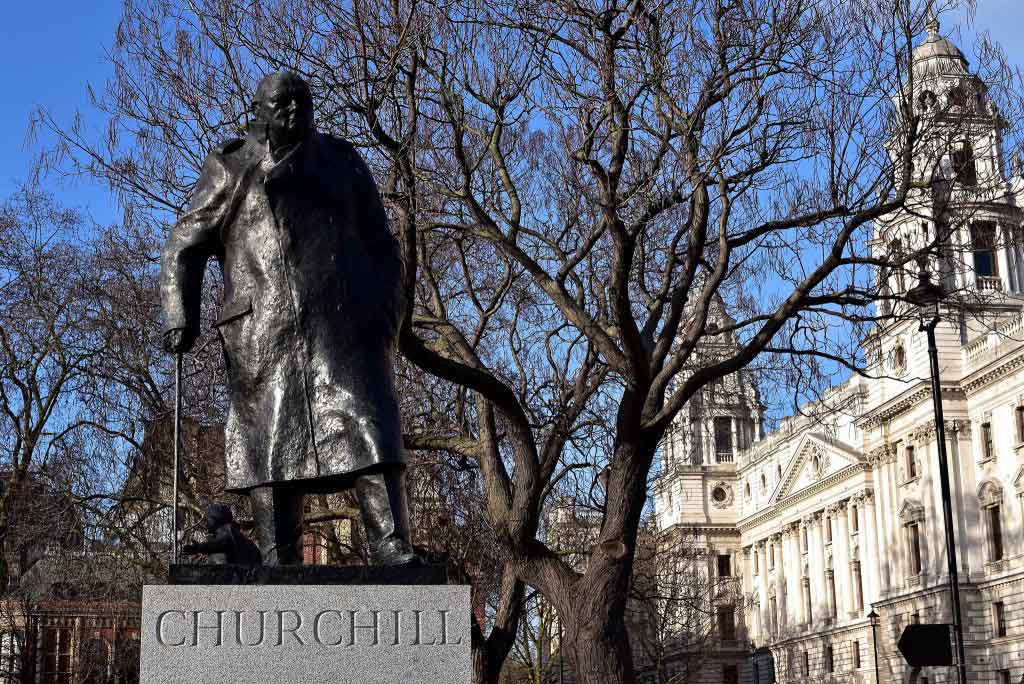
Winston Churchill, Parliament Square, London © Sue Lowry & Magellan PR
April 17, 2013
Page 11
Finest Hour 152
By Richard M. Langworth
In keeping with the theme of the March Churchill Conference in Charleston, South Carolina, we assembled this issue around Churchill and the Media, introduced by Daniel Myers. A conference paper by Allen Packwood explains how young Winston used the press to make a name for himself.
Warren Kimball’s and Admiral Thomson’s account of Churchill and the delicate issue of censorship reminds us that the need for qualified secrecy never changes. Today’s contentions over the Wiki-leaks scandal, and the all-too-public comments by leaders on the Bin Laden assassination, might be fewer if the states of war, from Korea to Libya, had actually been declared, as in olden time. Perhaps Ministers or Secretaries of Defense should have kept their original titles as Ministers or Secretaries of War, as politically incorrect as war is in America that would leave “Defense” as a more agreeable and appropriate name for the Department of Homeland Security.
“Mr. [Joseph] Chamberlain loves the working man,” Churchill cracked in 1905—”He loves to see him work.”1 We might say Mr. Churchill loved the media—he loved to see them wriggle, trying to extract from him one single word on actual policies. Read the transcripts of press conferences during Churchill’s Washington visits in 1941 and 1943, and our Wit & Wisdom department, for dealings with the press that are a model for today’s politicians.
“The Curious Case of William Griffin” is an exception to Churchill’s normal media experience. He found it quite impossible to handle Griffin, who sued him for a million dollars. My account, and Michael McMenamin’s exception, may produce disagreement, which is what Michael and I hope. “Nothing in the rules or intercourse of the Club shall interfere with the rancour and asperity of party politics.”2
Of course the press in his time—then almost entirely newspapers—was much more quiescent, respectful and undemanding than the gigabyted, internetted, hungry, biased and jaded 24/7 media of 2011. You may ponder how Churchill would handle today’s media, nurtured in the Grievance Culture, disillusioned by assassinations, wars, natural disasters, presidential and ministerial upheavals, and terrorist attacks on innocents. Well you might.
When I grew up, in the distant Middle Ages, none of these events was seriously conceivable. Perhaps the loss of innocence and the disillusionment that comes with age is a recurring process. Churchill had similar regrets when he wrote of his own youth in the Victorian age, “when the strength of our country seemed firmly set, when its position in trade and on the seas was unrivalled, and when the realization of the greatness of our Empire and of our duty to preserve it was ever growing stronger.” The “dominant forces” in those days “were very sure of themselves and of their doctrines. They thought that they could teach the world the art of government, and the science of economics….Very different is the aspect of these anxious and dubious times.”3
Martin Gilbert’s “Churchill and Eugenics” was written to destroy the myth that an “ashamed” Randolph Churchill covered up his father’s embarrassing ideas. Some critics use the issue to place Churchill on the Holocaust level, alongside Hitler, who not only rounded up the feeble- minded but put many of them to death. Like most lies, this one involves a kernel of truth: Churchill in the early 1900s did reflect a conventional belief of his time, that the “feeble-minded” should not be allowed to reproduce. But Randolph never covered it up; he simply never saw the documents.
In “Churchill and Sterilisation” (FH 131), Paul Addison wrote: “Churchill’s intentions were benign, but he was blundering into sensitive areas of civil liberty.” And yet, Addison continued, “It is rare to discover in the archives the reflections of a politician on the nature of man. Churchill’s belief in the innate virtue of the great majority of human beings was part and parcel of an optimism he often expressed before the First World War. In his view, sterilisa- tion was a libertarian measure intended to free unfortunate individuals from incarceration.”
Endnotes
1. Herbert Vivian in Pall Mall, April 1905, quoted in Richard M. Langworth, Churchill By Himself (New York: Public Affairs, London: Ebury Press 2008, reprinted 2010), 329.
2. Rule 12 of The Other Club, the political dining club founded by Churchill and F.E. Smith, Lord Birkenhead, in 1911.
3. Winston S. Churchill, My Early Life (London: Thornton Butterworth, 1930), 9-10
Explore
Related



Subscribe
WANT MORE?
Get the Churchill Bulletin delivered to your inbox once a month.