Exhibit Gives a Back Room Glimpse of World War Two
By Nick Olivari
Reuters Life! - NEW YORK- Documents and personal letters from world leaders provide a glimpse of the back drop to key historical events and a new exhibit highlights several from the defining event of the 20th century -- World War Two.
In conjunction with the Museum of World War Two, a private collection of artifacts outside Boston, and coinciding with the release of the book "World War II: Saving the Reality," the exhibit at the Kenneth Rendell Gallery marks the 70th anniversary of the Nazi invasion of Poland and the beginning of the war.
Kenneth W. Rendell, 67, the gallery owner, author of the book and founder and curator of the museum, has spent a lifetime collecting the letters and documents that reflect the leaders on all sides who were responsible for the dislocation of millions, and shaped the world as we know it today.
Brendan Gleeson has been named outstanding lead actor at the annual Emmy awards, beating Belfast's Kenneth Branagh to the title.
The Dubliner won the award for his portrayal of Winston Churchill in the acclaimed biopic Into The Storm.
Accepting the award, the 54-year-old said: "Now there's a turn-up for the books."
He went on to give an emotional speech, thanking the production team for giving his parents the chance to see an early cut of the film. His mother died shortly afterwards.
Gleeson got the nod ahead of Branagh, Sir Ian McKellen and Kiefer Sutherl and. Branagh was nominated for his portrayal of Swedish detective Wallander.
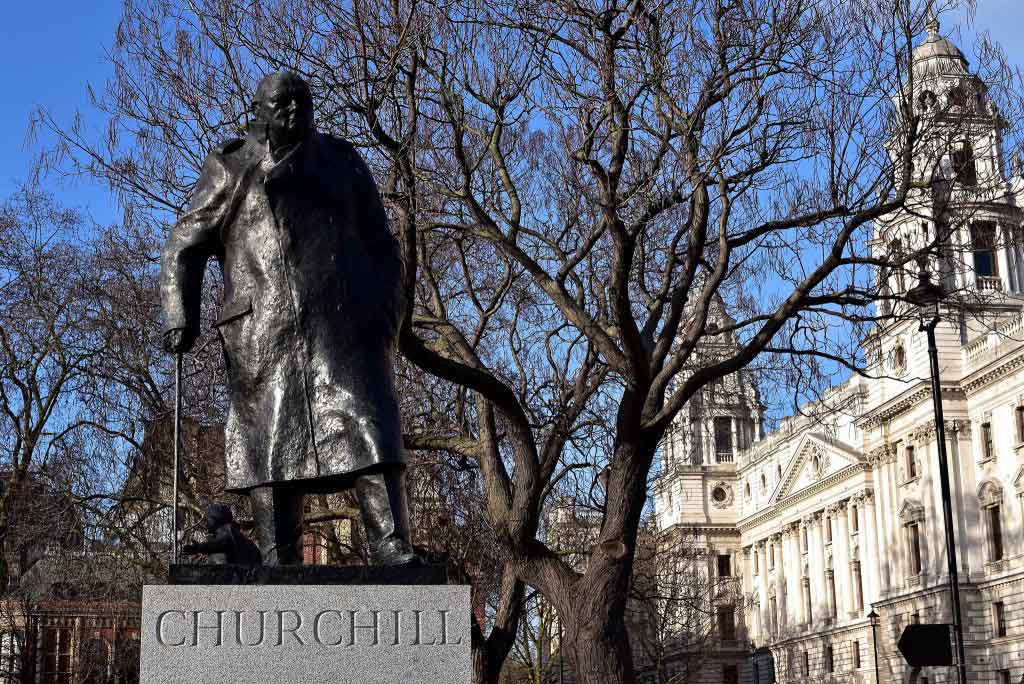
Sir Winston Churchill's place in the pantheon of British history is assured. Or is it?
The essayist Christopher Hitchens once wrote that Churchill "was not a figure in history so much as a fi
gure of history". And it cannot be denied that Churchill stands alongside Shakespeare, Newton and Queen Victoria as a towering presence in the British story.
Today, exactly 70 years after Britain declared war against Germany, the debate still continues as to whether he was truly great. Churchill's vast reputation rests not only on his well-documented and long life but also on his own voluminous, self-penned, memoirs.
Churchill was more a liability than an asset to the free world
The Great Debate 3 September 2009
Motion Proposed: Churchill was more of a liability then an asset to the free world.
Intelligence² audience confirms 1194 to 181 votes against the motion.
Does the fact that Winston Churchill is routinely cited as Britain's greatest hero say more about us than it does about him? Yes, he warned us of the need to face down Hitler when others were urging appeasement and yes, he gave a good speech. But what of his tendency to initiate disastrous military campaigns - think of Gallipoli in World War I or Norway in World War II. What of the fact that his generals constantly had to restrain him from embarking on even more madcap ventures? Could it be that the British had - and still have - a deep need to lionise their war leader in order to disguise from themselves the relative insignificance of Britain's contribution to defeating the Nazis in comparison with that of the Soviet Union or America? Is our refusal to diminish Churchill's stature born of the fear that we may have to diminish our own?
Melvyn Bragg: memories of the outbreak of World War II
Seventy years ago this Thursday, Neville Chamberlain announced that Britain was at war with Germany. For a new documentary, Melvyn Bragg sought the recollections of people - from evacuee to aristocrat, soldier to refugee – on whose lives that first day of conflict left an indelible imprint.
By Melvyn Bragg Published: 11:43AM BST 02 Sep 2009
The 'voice’ of the BBC in 1939 was that of Alvar Lidell; a measured, cultivated tone, calm and authoritative. It is probably true to say that almost everyone in Britain was listening to what was then called the wireless on the morning of Sunday, September 3 1939. The wireless had become the oracle through which the nation was to learn its fate. 'At 11.15,’ Lidell said, 'that is, in about two minutes, the Prime Minister will broadcast to the nation. Please stand by.’
Winston Churchill is continually quoted and misquoted, used and abused
Thursday, 3 September 2009
Seventy years ago today Neville Chamberlain gave his famous broadcast telling the nation that we were at war, before Parliament met in emergency session that Sunday morning. Among those who spoke was the newly-appointed First Lord of the Admiralty, in one of the shortest and finest speeches of his life, one of the least known – and most relevant today.
For 10 years Winston Churchill had been out of office – through his own choice – well before he became the most prominent critic of appeasement and of the Munich agreement in September 1938. Within months of Munich, that policy was seen to have failed, as the rump of Czechoslovakia fell apart and Hitler arrived insolently in Prague. There was much clamour in the press for Churchill to be brought back into government, but Chamberlain waited until his return to the Treasury Bench became as inevitable as the war itself. Related articles
BBC Marks 70th Anniversary of WWII with New Archive
27 August 2009
The BBC Archive is today launching a new online collection dating back to 1939, as part of the corporation's plans to mark the 70th anniversary of the Second World War.
Documents, a new image gallery and 20 rare recordings dating back over 70 years have been made available online for the first time, giving a unique insight into the how the BBC prepared the country, and itself, for the outbreak of the Second World War. Never-before-seen internal BBC documents and historic radio broadcasts have been released, including Richard Dimbleby reporting on Neville Chamberlain's return after signing the Munich Agreement, Chamberlain's declaration of war, and King George VI's radio address to the nation.
AM | abc.net.au/am (28 Aug 2009) - An exhibition celebrating the work that went on in Winston Churchill's wartime bunker has opened in Whitehall in London.
Seventy years ago this week, the famous war rooms became operational. It was the week before Germany invaded Poland. Britain was yet to declare war. The typists, secretaries and telephonists in Churchill's underground bunker were among the forgotten heroes of World War II.
Women like Myra Collyer helped to plan every step of the war against Nazi Germany.
"It was 75 pence a week wages, I remember that, and we couldn't do much on that," she said.
"I don't know, we got two pounds 10 shillings," said another former secretary.
"Oh I didn't, how did you get that?" said Ms Collyer laughing.
Edinburgh Festival 2009: My Darling Clemmie, review My Darling Clemmie is a moving production about Winston Churchill's complex relationship with his wife.
By Elizabeth Kirkwood, Edinburgh Festival Published: 5:48PM BST 07 Aug 2009
Winston Churchill’s claim that his most brilliant achievement was to persuade his wife to marry him is given ample support in Hugh Whitemore’s play My Darling Clemmie. Following the success of his TV film, The Gathering Storm, which focused on the turbulent nature of the marriage between Churchill and his wife, Clementine, Whitemore returns to this fascinating partnership with a one woman show.
Victoria, B.C., March 9th— I knew Ron Robbins only by letter or over the phone, but on countless occasions for twenty years I was glad to have him there. Ron had observed Churchill as a young reporter in the House of Commons, and knew him intimately, with an intimate appreciation that was never diminished by firsthand experience. Ron was Old School, possessing neither computer nor cell phone. He preferred to send fastidiously typed contributions, rarely corrected with White-Out. For that reason, when FH senior editors began to communicate frequently by email, we bumped him to Editor Emeritus.
He was a dear friend, and even though he made it to 93, it is very sad to know those contributions will end, though a number sent recently remain to be published. His generosity to the magazine was profound, his praise of its editor deeply encouraging. Herewith by kind permission of the Globe and Mail, secured through the offices of Terry Reardon of ICS Canada, a report by someone who knew him well. RML
Rachel Thompson, director of special projects at the George C. Marshall International Center in Leesburg, spoke to the Washington Society for Churchill summer picnic on August 2nd about the extensive correspondence between Churchill and Gen. George C. Marshall, the U.S. Army chief of staff from 1939 to 1945. Using color copies of examples of that correspondence, Thompson underlined that though the two men demonstrated dramatically different personalities, and often disagreed on matters of wartime strategy, they held each other in the highest esteem. The stream of letters continued after the war, including Marshall's hand-written thank-you notes for signed volumes of Churchill's history of the war, and concerning the June 1953 coronation of Queen Elizabeth II, where Marshall represented then-President Eisenhower.
Karsh widow recounts Roaring Lion tale as part of festival marking 100th birthday
He was young, polite, and a rising star in the world of photography.
His subject was the British prime minister, determined and defiant against the enemy during the Second World War.
In several moments in the Speaker's Chambers after Sir Winston Churchill had addressed Parliament in 1941, Yousuf Karsh took two photos, creating the most famous image of Churchill and in the process, turning himself into a legend.
Sixty-eight years later, Estrellita Karsh told the story surrounding the moment in almost the exact spot where her late husband and Churchill stood when the iconic photo was taken.
"Yousuf said to Winston Churchill, ‘I hope I can make a portrait of this occasion,'" said Estrellita Karsh at an event at the Speaker's Chambers yesterday, where she talked about the "Roaring Lion" portrait of the prime minister.
Letters have revealed that Winston Churchill's key ally was his dentist - as his biggest fear was losing his ability to speak because he had problems with his teeth.
Throughout his life, the statesman feared that problems with his teeth would affect his public speaking, one of his most powerful attributes.
So our country's greatest ever Prime Minister enlisted the most acclaimed dentist of his generation - Sir Wilfred Fish.
A World War II flight engineer dishes on the most "I" of the VIPs he flew with.
By Graham Chandler
Winston Churchill was anxious to leave the country. It was July 1942, and he wanted to go to Cairo and Moscow to confer with his generals and with Soviet leader Josef Stalin, but the pilot assigned to fly him urged caution. "I'd like...a bad night to get out of England to go to Gibraltar," William J. Vanderkloot told the British prime minister. Years later, he explained to his son, Bill, "I didn't want to get shot down over England." Read more...