Sign up for our free Churchill newsletter:
Churchill in the News
Darren Clarke's (British) Open Inspiration Print E-mail

By James Murray

SUNDAY EXPRESS, 17 July 2011 - GOLFER Darren Clarke holds a ball in between his fingers in a Churchillian V for Victory sign with the wartime PM the inspiration for his great form.

The 42-year-old Ulsterman was the surprise joint leader after two days at the Royal St George's course at ­Sandwich, in Kent, showing his prodigy Rory McIlroy, 22, that he is still a force to be reckoned with.

Darren says he is being inspired to win The Open Championship by the words of Sir Winston Churchill – and the love of his fiancee, former beauty queen Alison Campbell.

Churchill's speech, "We will fight them on the beaches" have certainly set cigar-loving Darren up for battle at a windy and rainy course this weekend.

Genial Darren has revealed that the new happiness and stability in his life is paying dividends.

At Christmas he announced his engagement to blonde former Miss Northern Ireland Alison. Darren, whose wife Heather died of ­cancer in 2006 aged 39, said: "Meeting Alison has put my life back on track."

Millions warmed to him after he ­courageously battled to help win the Ryder Cup for Europe against the US in Ireland a month after his wife's death.

Last Updated on Tuesday, 02 August 2011 14:19
Read more...
 
David Cameron Plants Churchill Rose in Garden of Number 10 Downing Street Print E-mail

Finest Hour 152

LONDON, July 14th — The second breed of hybrid tea rose named for Churchill, developed by Churchill College to mark its 50th anniversary last year, was planted in the garden at Ten Downing Street by Prime Minister David Cameron.

The first "Rose Sir Winston Churchill," a pinkish orange variety with strong fragrance which blooms throughout the year, was developed in 1955 by Alexander Dickson III. The new Churchill rose, developed for Churchill College by Peter Beales Roses in Norfolk, a peach-coloured variety, debuted earlier this year at the Chelsea Flower Show.

Churchill's daughter Lady Soames, Patron of the Churchill Centre, gave Cameron "firm instructions" on how the rose should be planted as Churchill College Master Sir David Wallace and Richard Beales of the Norfolk firm looked on.

The new rose is also now planted at Chartwell, where there is a long tradition of rose-growing in the gardens designed by Clementine Churchill and Victor Vincent. On the way up to the house from the visitor centre is the Lady Churchill Garden, devoted to hybrid tea roses. On the other side of the house is the Golden Rose Walk, bordered by spectacular yellow varieties given by their family to Winston and Clementine on their Golden Anniversary.

Several plants and trees other than roses are named for Sir Winston, as noted by the late Douglas Hall in Finest Hour 81 (1993). "How better to keep the memory green," Hall wrote, "than to fill your garden with a collection of plants named in honour of WSC?" We offer herewith Mr. Hall's roster:

Chamacyparis lawsoniana Winston Churchill is a golden evergreen, one of the showiest of this huge family of conifers. Slow growing and of medium height, it reaches six feet in about ten years. It should be planted in full sun to encourage it to retain its bright golden colour, which remains spectacular on dull winter days.

Fuchsia Winston Churchill was first bred in the USA in 1942 and, after more than fifty years, remains a favourite. It is very colourful with a deep pink tube and sepals, and petals of an almost luminous lavender.
Michelmas Daisy Aster Novi-Belgii Winston S. Churchill is another old variety with rich ruby-red petals and bright yellow centre.

Narcissus Sir Winston Churchill features double creamy-white flowers with an orange-red cup. A fairly tall variety, it grows to around 16 inches and is late flowering. It is best left undisturbed to naturalise on banks, between shrubs or in not too heavily-shaded areas beneath trees. Bulbs are widely available.

Rhododendron Azalea Mollis Winston Churchill grows to five feet with a five-foot spread after ten years in a semi-shaded position, requiring acid soil.

Saxifraga Winston Churchill is a rock garden perennial, preferring partial shade which sends up soft pink flowers about 6 inches high in April and May, from a bright green mound of mossy leaves. It is widely available including by mail order.

Last Updated on Monday, 08 August 2011 14:42
 
BBC News Visits Churchill Sculpture in House of Commons Print E-mail

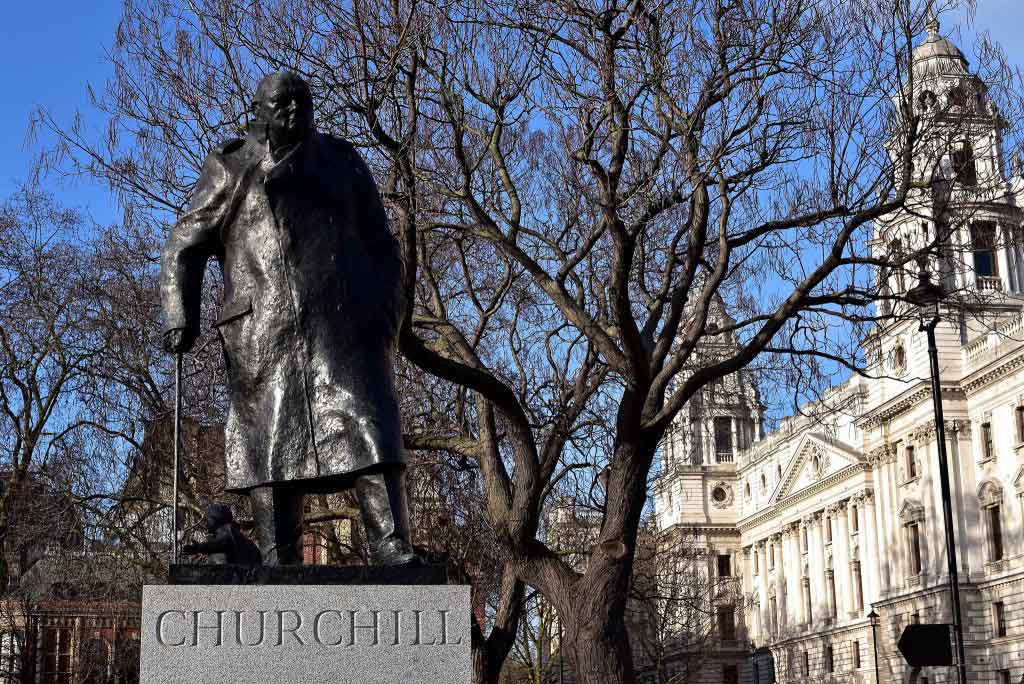
BBC NEWS, 10 July 2011 - There was a mutual admiration between Winston Churchill and sculptor Oscar Nemon, so it was natural that he would be commissioned to cast the figure of the former prime minister in bronze.

Because MPs considered it lucky to touch the bronze statue of Sir Winston, the foot of the figure had to be restored.

Follow this link to watch the video at BBC NEWS.

All rights reserved Copyright © BBC NEWS

Last Updated on Friday, 15 July 2011 14:00
 
George Watson: The Forgotten Churchill Print E-mail

COMMMENT BY THE CHURCHILL CENTRE
This is a very good and accurate article about Churchill's role as a creator of the welfare state, with an interesting point: that socialists resisted the "mixed economy" Churchill and Lloyd George favored, because they knew it would be the death of pure socialism. It's a stretch to conclude that Churchill favored the kind of National Health Service Labour enacted, or to say the NHS fostered expanded private health care: it expanded because the NHS was rationed and inadequate.

To say Churchill's books are "disappointing" and "needlessly extensive" is...disappointing. Leo Strauss called Marlborough "the greatest historical work written in our century, an inexhaustible mine of political wisdom and understanding." Nor are WSC's biographies "devoid of any sense of personal weakness." Books aside, this is a stimulating and thoughtful article about Churchill's lifelong Liberalism; and in Martin Gilbert's words "the modernity of his thought, the originality of his mind, the constructiveness of his proposals...." -Richard Lanworth, Editor Finest Hour


By George Watson

THE AMERICAN SCHOLAR, 3 June 2011 - He stares defiantly at the camera, a bulldog surprised, and everyone knows what he has in mind. It is December 1941, just after Pearl Harbor, and Winston Churchill is defying Hitler. Seated in Ottawa in the paneled room of the speaker of the Canadian House of Commons, he has just given one of the great speeches of history—the one about England's neck being wrung like a chicken—"some chicken, some neck." Canadian parliamentarians will roar back their sympathy and their support. Although only a few hours earlier Roosevelt's doctor, full of doubts, had visited him in Washington at the White House, he looks fit. At the age of 67 he has given the performance of a lifetime.

As his picture was being taken, though, he was not thinking about Hitler at all. Yousuf Karsh, the Canadian photographer of Armenian heritage who snapped him staring defiantly, has told the story. Churchill had been smoking a cigar in that paneled room, and the photographer, with the briefest of apologies, had just reached forward and snatched it from his lips. His speech is given, but he is wondering what has suddenly happened to his cigar.

The performance survives on film, and it is a masterpiece of theatrical timing, with a long dramatic pause between "some chicken" and "some neck" as the old stager slowly rotates his entire body nearly 180 degrees while a gentle chuckle swells into a roar, a roar into a cheer. That is the Churchill everyone knows—a consummate actor who could capture the mood of millions—and no one who saw it could ever forget it.

Last Updated on Monday, 27 June 2011 10:25
Read more...
 
Video Lecture: Churchill's Cold War Revisited Print E-mail

Here at the Wilson Center Online, they present a video of the lecture; "Churchill's Cold War Revisited".

Klaus Larres, author of Churchill's Cold War, revisits the contradiction between Churchill's 1946 "iron curtain" speech and call for German reunification in the 1950s.

This "National History Seminar" presentation is a joint effort of the National History Center and The Wilson Center.

The Wilson Center is the living, national memorial to President Wilson established by Congress in 1968 and headquartered in Washington, D.C. It is a nonpartisan institution, supported by public and private funds, engaged in the study of national and world affairs. The Center establishes and maintains a lively, neutral forum for free and informed dialogue.

Last Updated on Friday, 24 June 2011 13:14
 
Magnificent Obsession: Blenheim Palace Print E-mail

With its 2,000 acres, 187 rooms, and Masterpiece Theatre lifestyle, Blenheim Palace eclipses even the British monarchy's homes in the eyes of many. And for the three centuries since Queen Anne bestowed the land on the first Duke of Marlborough, his heirs have battled to keep it going. In a rare interview with the 85-year-old 11th duke, known as Sunny, and his fourth wife, the "exotic" and wealthy Lily, James Reginato explores the sacrifices made in Blenheim's name—from loveless marriages to a bitter legal battle—while Jonathan Becker shoots exclusive photos of the palace and its private quarters.

BY JAMES REGINATO

VANITY FAIR, June 2011 - For 300 years, Blenheim Palace, seat of the Dukes of Marlborough, has awed all visitors, even the grandest among them. "We have nothing to equal this," King George III said with a gasp to Queen Charlotte in 1786 as they caught their first glimpse of the Baroque behemoth, in Oxfordshire.

Indeed, Buckingham House, as the monarch's dwelling was then called, was primitive by comparison. With seven acres under its roof, Blenheim arguably still eclipses in splendor and magnitude any of the British royal family's homes, and it is the only nonroyal, non-ecclesiastical residence in England styled a "palace." Its grandeur registered even with Hitler, who according to wartime lore planned to move in after his invasion of England and thus ordered the Luftwaffe not to bomb it.

The palace's cornerstone was laid in June 1705, less than a year after the first Duke of Marlborough's pivotal victory against the French on the fields of Blenheim, in Bavaria. On behalf of "a grateful nation," Queen Anne granted Marlborough and his heirs the 2,000-acre royal manor of Woodstock, and Parliament voted to provide funds to build on it a suitably magnificent structure.

The problem was nobody thought to set a budget. To make a very long story very short, costs to build what was to be not just a home but a national monument had skyrocketed to £240,000 by 1711 (from the duke's initial guesstimate of £40,000), leading Parliament to cut off all funds. Meanwhile, political intrigue prompted Queen Anne to dismiss the duke and duchess from court, sending them into self-imposed exile abroad for two years.


SLIDE SHOW
Photos: Inside Blenheim Palace
The sprawling home of the Dukes of Marlborough for more than three centuries, Blenheim encompasses 187 rooms—from the sumptuous reception halls to the equally magnificent private quarters. Herewith, a virtual tour of Blenheim's grandeur.


Construction halted and did not recommence until 1716, now completely on the duke's dime. Over the next few years he poured in £60,000, even as he and his formidable duchess argued vehemently over aesthetic decisions—between themselves as well as with their long-suffering architect, Sir John Vanbrugh, who finally stormed off in a rage, leaving Nicholas Hawksmoor to keep things going (though the project was not completed until around 1733, 11 years after the duke's death).

Its maintenance has been an albatross for every succeeding generation of the family. As a consequence, the Dukes of Marlborough have sometimes had to make sacrifices. On occasion that has meant marrying for money, not love—the most famous example being the 1895 union of the ninth duke and Consuelo Vanderbilt, the poster heiress of the Gilded Age. It was the ultimate "cash for class" deal. Consuelo's socially ravenous mother, Alva, craved a duchess's coronet for her family, while his family sought the $2.5 million dowry she would bring (about $66 million in today's money).

Last Updated on Friday, 24 June 2011 12:50
Read more...
 
David Reynolds: Stalin's Weakness Almost Cost Him the War Print E-mail
Historian David Reynolds explains how the 'Man of Steel' came close to a breakdown

By David Reynolds

THE DAILY TELEGRAPH, 13 June 2011 - Seventy years ago this month, on June 22, 1941, the final act of the Second World War began. Or so Hitler thought when he launched three million troops into Russia. And he assumed it would be over in a few months. Instead the epic drama lasted nearly four years and, when the curtain finally did come down, it was in Berlin not Moscow.

Stalin, not Hitler, was the big winner of the War in Europe. My new BBC Four documentary – 1941 and the Man of Steel – explores how he did it and why it mattered. Russia's war still seems rather remote for us in Britain. We're familiar with epic battles like Stalingrad but not the big picture of the Eastern Front. Yet that is where the European war was won, at appalling human cost.

About 28million Soviet citizens died in the conflict, roughly one-seventh of the pre-war population. That body count reflects the savagery of the Nazi war machine but it's also testimony to Stalin's military ineptitude in the first year of the conflict.

Stalin means "Man of Steel" but in 1941 he was distinctly flaky. He dismissed a stack of intelligence warnings about the German build-up, convinced that this was British disinformation intended to drag him into their war. As a result, a quarter of the Soviet Air Force was destroyed on day one of the Nazi onslaught. Hundreds of thousands of Russian soldiers were encircled by the Germans.

A week into the fighting, Stalin finally realized the magnitude of the disaster. "Lenin founded our state," he told his colleagues, "and we've screwed it up." Although the evidence remains controversial, it seems that the Man of Steel came close to a nervous breakdown and feared he might be overthrown. Yet amazingly the Politburo asked him to take charge of a new War Cabinet. Even after Stalin had committed one of the biggest blunders in military history, his servile cronies couldn't imagine Russia without him.

Last Updated on Tuesday, 14 June 2011 11:20
Read more...
 
Did Hitler Give the Ok for Hess' Mission to England? Print E-mail

By Allan Hall

THE DAILY MAIL, 29 May 2011 - Rudolf Hess's flight to Britain during World War Two in a bizarre attempt to secure peace was backed by Adolf Hitler, fresh documents claim.

History has long recorded that the Nazi number three was acting alone when he piloted a Messerschmitt to Scotland in May 1941.

Rudolph Hess 1937He parachuted out over Renfrewshire and was arrested by a farmhand with a pitchfork.

Hess was, apparently, trying to contact the Duke of Hamilton to set peace talks with Winston Churchill in motion under his own initiative.

Hitler was even supposed to have scrambled aircraft to try to stop Hess, his deputy, from leaving Germany.

But a 28-page notebook discovered in a Russian archive disputes this theory and indicates that Hitler was in on the mission. It was written in 1948 by Major Karlheinz Pintsch, a long-time adjutant to Hess.

He was captured by the Soviets and spent years undergoing torture and interrogation at their hands.

In the notebook he writes that Hitler hoped that an 'agreement with the Englishmen would be successful'.

Pintsch notes that Hess's task – five weeks before Germany launched its invasion of Russia – was to 'bring about, if not a military alliance of Germany with England against Russia, then to bring about a neutralisation of England'.

Last Updated on Wednesday, 08 June 2011 10:59
Read more...
 
Obama Quotes Churchill and Shakespere on State Visit Print E-mail

The White House
Office of the Press Secretary

For Immediate Release
May 24, 2011

REMARKS BY PRESIDENT OBAMA AND HER MAJESTY THE QUEEN OF THE UNITED KINGDOM IN DINNER TOASTS

Buckingham Palace, London, United Kingdom
8:47 P.M. BST

HER MAJESTY THE QUEEN: Mr. President, I am delighted to welcome you and Mrs. Obama to London. Prince Philip and I are so glad that you are visiting the United Kingdom again.

We have fond memories of our first meeting during the G20 conference in London in 2009. It also gave me much pleasure to welcome Mrs. Obama and your two daughters here almost two years ago.

Your visit to this country inevitably reminds us of our shared history, our common language, and our strong intellectual and cultural links. It also reminds us that your country twice came to the rescue of the free and democratic world when it was facing military disaster. On each occasion, after the end of those destructive wars, the generosity of the United States made a massive contribution to our economic recovery.

Today, the United States remains our most important ally, and our two nations contribute to the security and prosperity of our peoples and of the world through shared national interests.

But our relationship goes far beyond our military and diplomatic ties. In your inaugural address, you spoke to the American people of the values that lay at the heart of your nation's success -- honesty and hard work, courage and fair play, tolerance and curiosity, loyalty and patriotism, and of the sturdy alliances an enduring convictions with which your nation had met past challenges and would meet future ones, too.

If I may say so, these values underscore much of the life of the United Kingdom, also. Together with our alliance, they continue to guide our actions as we confront the challenges of a changing world.

Last Updated on Thursday, 26 May 2011 16:34
Read more...
 
We'll Fight the Wind Farms Off the D-Day Beaches... Print E-mail

By John Lichfield in Paris

THE INDEPENDENT, Saturday 29 January 2011 - The view from the Normandy landing beaches is to be transformed – critics say "desecrated" – by an immense offshore wind farm.

French President Nicolas Sarkozy announced this week that one of the most poignant sea and beachscapes in the world – the Calvados coast, between Juno and Omaha beaches – had been selected as the site for one of five vast wind farms to be built off the French Atlantic seaboard from 2015.

Officials insist the generators, two-thirds the height of the Eiffel Tower, will only just be visible from the coast. But the leader of an official commemorative association and a militant ecologists' group said yesterday that France was failing in its duty to preserve the memory of D-Day, and the "essential character" of the five landing beaches on which 2,500 allied soldiers died on 6 June 1944.

The choice of the site, 11 kilometres off Courseulles-sur-Mer (Juno Beach), was "inappropriate and incoherent", Admiral Christian Brac de la Perrière, the president of the Comité du Débarquement, the official French body for commemorating D-Day, said yesterday.

"The French government says it wants the whole stretch of the Norman coastline from Utah Beach to Sword Beach to be declared a Unesco world heritage site," he said . "At the same time, it wants to build these generators in the very centre of the landing areas of 1944."

Jacky Bonnemains, president of Robin des Bois (Robin Hood), a militant French ecological group, said: "I find it extraordinary no one in government grasps that this will change forever the character of a place of sacred memory. They just don't seem to care." In future, the seascape would be "desecrated" by rows of wind generators, he added.

"The promoters and the government say the generators will be hardly visible but this is not so," he said. "They will easily be visible on a clear day and they will generate light pollution at night." Mr Bonnemains, whose group opposes all offshore wind farms, said there was already fear about unexploded wartime munitions near two wind farms off the northern Norman coast. "The seabed in the approaches to the D-Day landing beaches must be carpeted with unexploded bombs," he said.

France has no large offshore wind farms and wants to catch up with Britain and Germany. President Sarkozy announced on Tuesday a €10bn plan to build five giant arrays of generators off France's western coast from 2015. The sites – two off the north Norman coast, one off the D-Day beaches and two off the Breton coast – will generate as much electricity as two nuclear power stations.

Last Updated on Thursday, 19 May 2011 16:18
Read more...
 
"Profile for Victory" Portrait of Churchill by A.E. Cooper for Sale Print E-mail

Alfred Egerton Cooper 1883-1974 • British

"Profile for Victory" Portrait of Sir Winston Churchill (1874-1965)

Signed " AEC" (lower left) and signed verso "19 WSC 42 / by AEC"
Oil on canvas

Canvas: 20 1/16" high x 16 3/8" wide
Frame: 26 1/2" high x 22 3/8" wide

One of the most famous portraits ever painted of one of history's most recognizable figures, this starkly realistic portrait of Sir Winston Churchill by Alfred Egerton Cooper depicts the pugnacious statesman in 1942, during the dark, early days of World War II. In what would become the famed Profile for Victory portrait, Cooper deftly captures Churchill's legendary stubborn tenacity in the face of terrible odds in this oil on canvas. As Churchill was almost certainly Britain's greatest inspiration during this time, the painting was reproduced after its exhibition at the Royal Academy in 1943 as a successful propaganda poster. It also bears the distinction of being one of the very few portraits painted of the prime minister during the Second World War. Many well-respected artists have painted Churchill, but Cooper bears the honor of having painted him more than anyone else. Cooper enjoyed a jovial relationship with the great man, and perhaps consequently, this portrait is known to be one of Churchill's favorites.

At the time of this painting, Alfred Egerton Cooper was an internationally acclaimed portraitist. He was both ambitious and technically gifted, and his realistic style imparted a strong sense of glamour to European royalty, Buckingham Palace, the British Parliament and rich and powerful public figures who frequently sat for him. All of this did nothing, however, to further his chances of getting Churchill to pose for him and indeed, he was not officially commissioned to paint this portrait. He had, instead, managed to secure the chance to paint Churchill by accompanying his fellow artist, the sculptor William Reid Dick, as his "assistant."

One evening in 1942, Cooper was at the Arts Club in Dover Street playing billiards with a group of members. Among these was Dick, who related that he had been commissioned to sculpt a bronze of Churchill, and would soon be going to Downing Street to take preliminary measurements. Dick was a distinguished sculptor who was King's Sculptor in Ordinary for Scotland and President of the Royal Society of British Artists. Despite this, he had had to prevail upon King George VI himself to arrange a sitting with Churchill, who quite reasonably had said he did not have the time. Cooper asked if he might accompany Dick in the capacity of an assistant. It must also be noted that Dick's (and thus Cooper's) chances of securing sittings from Churchill were almost ruined by another sculptor, Clare Sheridan. In the early summer of 1942, Sheridan wrote a series of a wild letters to the Prime Minister demanding that he sit for her too, and, bizarrely, threatened to commit suicide on the steps of 10 Downing Street if Reid Dick was granted access, but not her. The ensuing row drew in Brendan Bracken, the Minister for Information, who advised against a plan to give joint sittings, warning that Churchill would be required to act as a mediator.

The seeds of Cooper's future relationship with Churchill were surely sown at that very sitting. Churchill sat while Dick took his measurements and read them off to Cooper, who recorded them as he quickly sketched Churchill's profile. Cooper had had the idea to do a series of "Profile" biographies of prominent persons in the Observer, and gave his sketch the tentative title "Profile For Victory." He then began his campaign to get permission for his own sitting. He showed the sketch to Churchill, who must have admired it and eventually agreed to sit for a portrait in that pose, but only after teasing Cooper about coming under false pretenses to make this request. The resulting portrait, considered by Cooper to be his finest work, was exhibited at the Royal Academy in 1943 and later published as a morale-boosting poster for the general public. The painting itself was purchased by Cooper's friend Sir Edward Mountain.Unlike his famous subject, who was born in the same year as he, Cooper had a quietly successful career. Best known for portraits, as well as for landscapes, coastal, harbor and horse racing scenes, Cooper showed artistic leanings early in life. He studied at Bilston School of Art and on a scholarship at London's Royal College of Art, from which he graduated in 1911, and at the age of 18, he exhibited for the first of 40 times at the Royal Academy.

After graduating, Cooper entered a competition being judged by, among others, the great John Singer Sargent. Impressed with the young artist's work, Sargent asked Cooper to work with him in his studio in Chelsea, which had once belonged to James McNeill Whistler. Cooper spent about a year as Sargent's assistant, painting backgrounds and details for his paintings,and was elected to the Royal Society of British Artists in 1914.

During World War I, Cooper enlisted with the well-known Artists Rifles. Following the war, he was made an official artist of the Royal Air Force. Thought his sight in one eye had been damaged by chlorine gas, he became an expert in the art and technique of large-scale aerial camouflage and painting landscapes from the air. Cooper exhibited his work in Paris and London, and in 1921, his painting London was a notable feature of the Royal Academy of Arts Summer Exhibition. Three years later, he won an Honorable Mention at the Paris Salon.

Artist's Collections:
London's Imperial War Museum
Minneapolis Institute of Arts, Minnesota
National Portrait Gallery, London
Royal Air Force Museum

Artist's Exhibitions:
Paris Salon
Royal Academy of Arts
Goupil Gallery, London
Leger Gallery, London
Leicester Gallery, London
Manchester City Art Gallery
Royal Institute of Oil Painters
Royal Institute of Painters in Water Colours
Walker Art Gallery, Liverpool

Artist's Memberships:
Chelsea Arts Club
The Carlton Club, London


Last Updated on Wednesday, 11 April 2012 17:23
 
BBC Archive: Churchill, the Man I Knew. Print E-mail

Voted by BBC viewers the greatest of all Britons in 2002, Winston Churchill remains a symbol of valiant defiance against adversity. Twice prime minister of Great Britain and Northern Ireland, he led the Allied forces towards their 'finest hour' and his funeral saw the largest gathering of world dignitaries ever assembled.Sir Winston S. Churchill

The state funeral of Winston Churchill is at the heart of this collection, which also includes personal memories of a man whose loss was deeply felt when he died, aged 90, on 24 January 1965. Each programme is a tribute to the man who claimed to have 'nothing to offer but blood, toil, tears and sweat'.

Visit the BBC Archive website here.

Last Updated on Tuesday, 17 May 2011 12:36
 
“American Thinker” Not Thinking Print E-mail

In a May 10th piece on the American Thinker website, author Robert Morrison asserts that a) President Obama is no Churchill; b) Hitler, who in 1940 was ready "to parachute 10,000 commandos on London," was rather scarier than Osama bin Laden; c) Obama, who dislikes Churchill for the torture of his grandfather in Kenya, "tossed" the bust of Churchill from the Oval Office; and d) just last week, "spilt his guts" on the media about the Bin Laden assassination.

Quoting Churchill's famous remark that when he became Prime Minister he felt as if he "were walking with destiny," Morrison writes: "I want my president to have concerns, but not fears. I don't want him to go on television and kvetch. I want my president to walk with destiny." Among the comments to this article is one asserting that Churchill and President Wilson "orchestrated a plan" to get America into World War I by sinking the liner Lusitania.

Dear oh dear.....

For writers to offer comparisons of today's politicians with Winston Churchill is remindful of what Churchill said (drawing laughs) to the U.S. Congress in 1941, just after the Japanese had attacked the United States at Pearl Harbor: "They have certainly embarked upon a very considerable undertaking."

"Kvetching" and the current incumbent aside, you simply don't parachute 10,000 commandos on a city, a feat beyond even Hitler's Luftwaffe. Also, Obama's grandfather was released in Kenya before Churchill returned to power in 1951. And Churchill actually expressed sympathy toward the Kenyan rebels. The details are here.

Last Updated on Monday, 16 May 2011 11:56
Read more...
 
Granddaughter to Help Dedicate New Churchill Sculpture in Fulton Print E-mail
Bas relief commissioned by Richard J. Mahoney

Edwina Sandys, Churchill's granddaughter, will help dedicate a new sculpture of Sir Winston Churchill created by noted St. Louis sculptor Don Wiegand at a special unveiling ceremony at 11 a.m., Friday, May 13, at the National Churchill Museum, located on the campus of Westminster College in Fulton, MO.


Sandys, an acclaimed artist herself, is responsible for "Breakthrough," a sculpture on Latshaw Plaza at the Westminster campus that she made from eight sections of the Berlin Wall in memory of her grandfather. The work is the longest contiguous section of the Berlin Wall found in North America.


"This new sculpture, which will be erected on the newly constructed Plaza in front of the National Churchill Museum, will create a much more dramatic entrance to attract visitors to our remarkable Museum," says Dr. Rob Havers, Executive Director of the National Churchill Museum. "The piece captures the decisive moment when Churchill vividly described the Iron Curtain that had fallen across the Continent and, in doing so, provided themetaphor that would encapsulate the Cold War for the next 40 years."


The bas relief sculpture showcases the moment when Churchill delivered the famous "Iron Curtain" line at Westminster College in his landmark address with a metaphor which defined the Cold War for a generation.


The sculpture is the work of Don Wiegand, a St. Louis artist of national and international reputation who has won countless awards for his work.


Born in St. Louis, Wiegand is responsible for numerous pieces in and around the St.Louis area, including the George "Buzz" Westfall Memorial in the St. Louis County Government Center's Memorial Park in Clayton. His work may be viewed at the Anheuser-Busch Visitors Center, Cathedral Basilica, Cervantes Convention Center, Jefferson Memorial Museum, Missouri Botanical Garden, and Lambert International Airport.


Outside of St. Louis, his work is on display at public institutions such as the John F. Kennedy Library, Mark Twain Home and Museum, Ellis Island, NASA Space Center, U.S. Senate Building, Texas Stadium, The Vatican and the White House.


His stainless bas reliefs of "Charles A. Lindbergh" and the "Spirit of St. Louis" became the first bas relief sculptures in space.


The Churchill statue has been donated by Richard J. Mahoney of St. Louis, who is a Churchill Fellow and a member of the Board of Governors. He is a longtime supporter of the Churchill Museum and a lifelong admirer of Winston Churchill. He was instrumental in the creation of the "Winston S. Churchill: A Life in Leadership Gallery" at the National Churchill Museum.


Last Updated on Wednesday, 11 May 2011 11:11
Read more...
 
Sweat and Tears Made Winston Churchill's Name Print E-mail
As the country votes on AV, a system Winston Churchill loathed, Nicholas Soames reflects on his grandfather's reverence for our institutions - and the toil he put into his speeches.

By Nicholas Soames

THE TELEGRAPH, 4 May 2011 - When Clement Attlee was asked if Churchill had been a great parliamentarian, he replied: "No, he was a great parliamentary figure."

To those outside politics, this might seem a fine distinction, and somewhat ungenerous to the author of some of the greatest speeches ever delivered in the House of Commons. But Mr Attlee, as so often, had made a wise comment. Nor was it in any way to Churchill's discredit.

Unlike his father, Churchill was not a natural speaker. Lord Randolph Churchill, in his very brief prime between 1880 and 1887, was the most brilliant platform speaker and parliamentary debater of the day. Lord Randolph was that relative rarity, a natural spontaneous debater in the Commons, quick to invoke the deadly weapons of mockery and irony, and acutely sensitive to the mood of the House.

But his son Winston had not inherited these gifts. For him, every speech, however brief, had to be carefully prepared - an agonising process for everyone involved. Indeed, there was much truth in the jibe of his greatest friend, F E Smith, that "Winston has spent the best years of his life composing his impromptu speeches".

People are always surprised that this most articulate of men was so dependent on prior preparation, even for minor speeches. Bob Boothby wrote, when he was Churchill's private personal secretary in the Twenties, of the prolonged nightmare of the preparation of a Churchill speech. It was a process that exhausted advisers, officials when in office, friends commanded to assist and very long-suffering and much put upon secretaries.

He never had a speech-writer and however many people might have been involved in the preparation of his major speeches, the result was entirely his own. But the laborious process of days of thought did not always mean that they were successful. Churchill's career was littered with oratorical disasters when he misjudged the audience. On these occasions, his admirers could only suffer as he ploughed on amid mounting tumult and hostility.

Last Updated on Wednesday, 04 May 2011 15:14
Read more...
 
<< Start < Prev 1 2 3 4 5 6 7 8 9 10 Next > End >>

Page 4 of 14